Showing posts with label Research Point. Show all posts

Wednesday, 23 July 2014

Assignment 5: Preliminary Research and Ideas


It was going to be necessary for me to use myself as a model for my final assignment because I wanted to do a lot of drawing and my two household models' patience was wearing thin. I am not yet confident enough to start drawing subjects who are less personally known to me and where flattery might be required.  I noted down a few ideas about how to handle the self portratiture. 


I wasn't dismayed at having to do a self portrait. I had noticed that on my gallery visits I had been interested in images of women. I had also found the research point on self portratits quite stimulating. I was, however, concerned that working on self portraits might be considered narcissistic. I though that the way to avoid this might be to look in great detail at parts of my face and body like I did in the 'using colour' exercise concentrating on the textures and colours. I would be treating myself like an object- a still life or landscape and hoestly depicting features that might be considered unattractive.  This was in part stimulated by seeing Michael Landy's drawing of his father's foot with peripheral vascular disease in his 'Welcome to my World' series. He describes the details of the foot in coloured pencil and treats it as an object with no particular emotional resonance even though clearly his father is someone very important to him. Click Here for a reproduction of this image from the book 'Vitamin D' New Perspectives in Contemporary Drawing.

I thought that by using the philosophy of Cartesian Dualism (separation of mind and matter) or viewing the body like a machine like the now largely outdated philosophy often used in medicine I could avoid accusations of narcissism. 

I worked on some drawings from this angle which are posted Here. During this process, it became apparent to me that to draw a completely objective drawing of myself is actually an impossibility. I can never actually step outside my own subjective experience and the very act of drawing goes through the process object-subject-object. Also the fact that I am worried that people might think I'm narcissistic is a vanity in itself so self-regard is not being avoided - it becomes a circular argument.  I decided that I needed to look more deeply into the depiction of women and also into the concept of narcissism as it relates to self portraiture. My tutor had asked me to read and comment on two chapters of the books from the reading lists in this section so I decided to include that research here. 

I started by reading the chapter "Fashion, Likeness and Allegory" in 'Drawing Now: Eight Propositions' Laura Hoptman MOMA 2002. 

This chapter compares the work of the Pre-Raphaelites of the mid 19th Century with the work of artists working today with an aesthetic which could be considered similar. Th Pre-Raphaelites used allegory and skill in decorative form - they integrated a decorative aesthetic with highly illustrative styles of portraiture - they used allegory to give their paintings a narrative based on myths, folklore or the bible. Because of their decorative aesthetic, their work was sometimes criticised as being shallow which as also a criticism which could be levelled at some of the contemporary artists included in the chapter. The artists selected combine to a certain extent the visual languages of fine art with that of commercial art. Elzabeth Peyton, Graham Little and John Currin are the cotemporary artists included in this chapter. I also reviewed their work which is included in the other set book 'Vitamin D - New Perspectives in Contemporary Drawing'
Elisabeth Peyton makes portraits of her won friends and of celebrities. She has her own aesthetic and her portraits all have a  similar air about them. The people in them tend to be lean with high cheekbones. They ooze 'cool' and have an insouciant and androgynous quality about them. She makes them look even more attractive than they are in real life. She portrays them as a fan would. Her 'aestheticising' of her subjects could certainly be compared to the decorative quality of the Pre Raphaelites.  Her subjects always have delicate features and pale faces. She works in washes of watercolours or in coloured pencil. The images also recall images of fashion illustration. To me they remind me of Kate Moss's 'waif' and 'heroin chic' look. 

In contrast to Peyton there are a number of artists who commment negtively on celebrity culture. Dawn Mellor makes her celebrities much less aesthetically pleasing. Her portraits are more like caricatures and in some cases quite grotesque for example Christia Aguiliera in "Christina Wieners" in which she is portrayed as Saint Sebastian in a hail of arrows or "Madonna Molotov" who is grotesque and has a white cane signifying blind belief in the media. This artist is included in "Painting People-The state of the art (Thames and Hudson - 2008).

Graham Little in the other hand does not portray celebrities. The women he paints are nameless and anonymous. They have a cool distance about their demeanour and poses just like fashion models and they model recognisable high end fashion. He uses great technical skill in his handling of coloured pencil and uses decorative surfaces and pattern. One particuar painting of his of a women in an orange D&G hoodie refers back to Lord Leighton's "Flaming June". It is difficult to say whether Little's work is a daring mix of high fashion and fine art or is it is just drawing aimed at fashionistas. His drawings are certainly technically skilled and his rendering of light is quite beautiful but the remoteness and coldness of his models mean that they don't appeal to me. I suppose he is only reflecting back images from today's media so his references are contemporary but the drawings themselves don't do anything for me.

The drawing which moved me the most out of the work of all the artists in this chapter was 'The Moved Over Lady' by John Currin. (I wrote about the work of John Currin in section 4 and will not go into detail again here) This is an unassuming little drawing of an unassuming and ordinary woman. She is clearly middle aged with a fairly shapeless body and a very ordinary short hairstyle and she is rendered in shades of grey. Everything about her is average and unexciting. She is essentially bland and unglamorous so why would he choose to draw her and why should this drawing excite me more than most? This picture resonated with me as it is about the anonymity of middle age - something which I am coming to understand at the moment. This drawing has strongly influenced my preparation for assignment 5. 

I next went on to read John Berger's 'Ways of Seeing' (BBC and Penguin Books 1972) and I also watched the BBC series which is available on 'You Tube' online. I have only chosen one chapter to mention here. I chose Chapter 3 (Episode 2 of the Series) which is about images of women - in particular paintings of the female nude because it is the chapter to which I had the strongest reaction.  The first few lines of Berger's narration of the episode immediately set my teeth on edge and made me bristle with indignation:
"Men dream of women, women dream of themselves being dreamt of. Men look at women, women watch themselves being looked at"
"Behind every glance is a judgement"
" A Woman is always accompanied by her own image of herself" " She is taught to survey her own femininity"
A woman's "Appearance to men is though of as the success of her life". "A woman is first and foremost a sight to be looked at"
He also states that the internal observer inside each woman has a masculine viewpoint. 
All the above statements are intercut with images of women from an old and fat lady struggling along the street to beautiful young models.
I would like to think that we've made some progress since the 1970's in particular on the assertion that the success of a woman's life is dependent on her apppearance to men. However, a bit like fish when asked to describe water which replied "what's water", when something is so prevalent and all encompassing in society it can be difficult to identify it from within. I'd like to think as a professional woman that I would be judged on my abilities rather than my attractiveness. However, I do agree that women are taught to survey their own femininity, and if I am were immune to this why wuld it be difficult to accept the changes to my body and face that occur with middle age and menopause? However, I would take issue with Berger saying that my intenal observer is masculine - I don't think this is true. I think that when women are fearful of judgement they are more swayed by the opinions of other women than those of men. 
All the controversial statements that Berger makes, precede a discussion of the nude in European painting. 
Berger talks about the distinction between being a nude and being naked. Nude paintings generally depict women and are about objectification. The woman is seen as an object and not recognised for herself. She is on display for the enjoyment of a male observer. There are a few exceptions to this in which the painter has rendered a sensitive depiction of the particularities and the character of the model who is someone personally known to them. These womed are naked - without disguise ad as themselves.
Durer's attempt to create the ideal female nude using parts from various models takes this objectivication and disinterest in the individual personhood of a woman to a whole new level. Given that humanism was on the rise at the time and this was when 'individualism' first became important there is a major double standard here. Durer saw the artist as an erudite individual. A thinking man. He wanted to raise the status of artists. However, he is content to disregard completely the individuality of the woman he is painting. 
Berger then goes on to talk about Renaissance images of Adam and Eve whic depict the moment when they start to feel shame. The woman is blamed and becomes subservient to the man as punishment. 
Another popular Renassance theme was "Susannah and the Elders" in which we as the viewers join in as voyeurs along with the elders. Berger alsi outlines the hypocrisy of images purporting to represent female vanity ( women looking at themselves in the mirror) when the women have been stripped and put on display for the enjoyment of men. 
The women in nude paintings know they are being observed. They Look out from the paintings wearing expressions which suggest sexua availability. These expressions are repeated in photographs of women made to appeal to men for advertisements in glossy magazines. (See Below- there are also female archtypes here such as the mother and child suggesting the purity of the Madonna) 


The woman is made to appear that she is passive with no will of her own. This is illustrated by Charles II's painting of Nell Gwynne by Peter Lely - she is submissive - Charles wanted to display her as a possession. In European paintings, even when there is a male lover with the woman, the woman looks out at the observer rather than at the lover. (See the image of the man and woman together above) The main player/protagonist is the observer who is assumed to be male. This contrasts with other types of art (Eastern, Pre-Columbian and African art for example) in which sexual activity is depicted with the male and female both being active participants.

Traditional nudes are hairless. Berger states that this is because hair is associated with sexual passion which was meant to be the preserve of the masculine sex. I was quite amazed to find an article in the Guardian recently which detailed the removal of a painting from the Mall Galleries in London from this year's exhibition of the Society of Female Artists.  The painting was removed because of an outcry. The painting " Portrait of Ruby May Standing" by Leena McCall shows a woman standing. She looks quite directly out of the canvas. She is smoking a pipe and wearing a waistcoat and breeches. Th ebreeches are undone at the front revealing her pubic area. Apparently this was deemed 'disgusting' and 'pornographic' and the gallery was forced to remove it after numerous complaints. There is nothing remotely pornographic about the painting. I find it quite bizzare that there should be such consternation over a small glimpse of pubic hair. Especially considering that the gallery replaced this painting with a more traditional passive nude.

Berger contrasts the nude again with the concept of nakedness. The naked body is banal. On stripping and seeing the partner naked there is a loss of mystery but there is the promise of sex. He talks of sex as a process  and as a shared mystery and therefore static images of sexual nakedness can become chilling and off-putting. 
In modern art the classic category of the nude has become less important. Manet came at the end of this cycle of the female nude and his Olympia was the beginning of the end for this genre of painting. If we compare Titian's Venus of Urison  1487 -1576 with Manet's Olympia 1832-1883 we can see that the Venus is a typical passive nude, she is there inviting male pleasure. Manet's Olympia depicts a prostitute. She gives us a direct gaze. She is offering herself for sale and almost seems to be goading the male onlooker to see if he is able to fantasise about her when she is offereing herslf in a very direct way.  In an essay my Mary Elisabeth Williams on Manet's Olympia, the Author states " To worship a godess is easy, but to love a human - especially when there is no hint of reciprocation is far more work and infinitely more thrilling. Manet brough the hidden world of the everyday to light and made it remarkable"

At the end of this chapter of the book, Berger urges the reader or spectator to replace the woman in one of the paintings or photographs with a man and 'observe the violence it does to the image'. Yasumasa Morimura is a male Japanese male artist who has done just that in his 'self portrait as art history' series he superimposed his own features onto among others the face of Frida Kahlo and Manet's Olympia thereby collpsing both gender and cultural boundaries. 

As well as loking at images of women and fashion, I also touched earlier on the subject-object dichotomy which is an area of interest in contemporary art at the moment. There are some quite complex philosophical arguments surruounding this which are to do with trying to avoid subjectivity and identify with objects. Discussion of this is beyond the scope of this research point. However I recently read an article in Art Monthly entitled 'I object' which talks about some of these issues and includes reference to Mark Leckey's "the universal addressability of dumb things" some of which I saw at the Venice Biennale last year. However, before I digress too far, the point of this is that the title of this article  " I Object" indirectly led me to the work of Hannah Wilke and full circle back to the concept of Narcissism". 

Hannah Wilke's work "I Object- Memoirs of a sugargiver" 1977-78 consists of two photographs of her lying naked on some rocks. It is a statement about reclaiming the female body from the control of male artists. Her body is strong and tanned and in one of the photographs she looks directly into the camera. This was a response to Wilke's objection to the pale and anonymous rape victim in Duchamp's "Etant donnes". The title is clearly wordplay on the objectification of women. 
Hannah Wilke was a young and attractive woman and therefore many feminists dismissed her as a narcissist.  I found an essay by Jennifer Linton (JenniferLinton.com) entitled "Feminist Narcissim and the Reclamation of the Erotic Body" which was prepared as part of a graduate programme in fine arts. In this essay, Linton talks about narcissism. The vernacular use of the word is taken to mean the pathological sort of self regard and vanity and it is often directed at women. Linton posits feminist narcissism as a positive sort of self love. When feminists dismissed Wilke as a narcissist they were using it in the vernacular context in an anti female context which seems quite odd behaviour. 

Having looked at Hannah Wilke, I also came accross the work of Rosy Martin and Jo Spence and was partularly disturbed by one of her "Photo therapy" works in which text is projected onto an ageing female body - "The vagina begins to shrivel.....  " from Everything you always wanted to know about sex but were afraid to ask" 1969 and also " After women have lost their genital function....." Sigmund Freud " the dispostion to obsessionsl neurosis 1913"

So I've come round in a big meandering loop back to issues of narcissism, objecthood and ageing. There's plenty to think about here and a starting point for some investigation.

Reference Material Used:

Drawing Now: Eight Propositions. Laura Hoptman (MOMA 1992)

Vitamin D: New Perspectives in Drawing Emma Dexter (Phaidon 2005)

www.rosymartin.info/performative_body.html

Ways of Seeing John Berger (BBC and Penguin Books 1972)

I Object - art and the new objecthood Maria Walsh (Art Monthly Nov 13; 371, pp 9-12)

Painting People- The state of the Art Charlotte Mullins (Thames and Hudson 2008)

Feminist Narcissism and the Reclamation of the Erotic Body (Prepared for a graduate class in contemporary art theory York University Ontario May 2009) Jennifer Linton (Jenniferlinton.com)

"Pornographic and disgusting" painting removed from top London exhibition because it features a woman's pubic hair" Adam Withnall , The Independent, 8th July 2014



Saturday, 19 July 2014

Research point: Artists' Use of line

Artists' Use of Line
Much of the information I have written in this section has come from 'The Linear Economy' in 'The Primacy of Drawing- Histories and Theories of Practice' by Deanna Petherbridge. (Yale University Press- 2010)

Line drawing can take many forms- not just pencil, pen or charcoal on paper. We can draw on steamed up window with a finger or a line in the sand with a stick. Many artists have employed alternative media for drawing with line. Marcus Raetz made drawings from Twigs, Garbriel Orozco drew lines with bicycle tyre going through a puddle. Picasso drew in the air with a torch and had the drawings captured on film. Land artists make lines by walking or carefully placing natural materials.

A line is a directional mark and can be used to represent many different things including movement, spatial relationships, texture, volume. Lines are often used in drawing to represent lines that are perceived but do not actually exist - that is they define the effects of light and mass to represent the boundary of an object. This is a convention - it is not a transcription of reality as the line drawn is not actually there.

Lines can be varied in many ways: Thickness, pressure, speed of drawing, and medium. The appearance and gesture of the lines produced may be nuanced by the emotional or physical state of the artist or lines may be drawn in a completely uninflected way as a simple outline (something Petherbridge has termed 'dumb line'). Lines may also be affected by the skill level, education and degree of hand-eye co-ordination of the artist.

The response of the viewer to the line is also dependent on several things:
  • The viewer needs to have some familiarity with the conventions of the use of lines in drawing. Is this something we are all born with or is it learnt? Young children understand drawings before they can read. Drawing has been around as a system of communication before writing. Deanna Petheridge talks about 'the primal nature' of drawing.
  • The viewer applies a sort of cognitive mapping to interpret the lines of a drawing
  • The viewer may respond to the expressivity of the medium
  • They may respond to the subject matter
  • They may respond to the gestural nature of the marks or the inflection of the lines.
Paul Klee, categorised lines and forms in his 'pedagogical sketchbook' He divides them for example into 'active' and 'passive' lines. Klee famously talked about 'taking a line for a walk' and the fact that a line is a record of the movement of the artist's hand - it is movement fixed in a permanent record (actually it may not be permanent as drawing also can include the process of erasure). In the quotation below, Klee talks about the viewing of a drawing.

"Thus the eye, like a grazing animal feels out the terrain, not only from top to bottom but from left to right and in all directions for which it feels the need. It travels paths laid down for it in the work which itself came into being through movement and became fixated movement."

The research point was to look at several artists and their use of line:

Clean Classical lines- Elegance


J.L. David (1748-1825)
A French neoclassical artist - in reaction against the prevailing Rococo style which he saw as frivolous. You can clearly see the influence of classical Rome/Greece in his clean lines especially in the drawing on the right. There is a delicacy to the lines and hatching he uses to describe the face of the woman. It is not overblown or overly complicated.

Sensual (serpentine) Lines:

Ingres (1786-1867)
Ingres was a student of David. He maintains this strong neoclassical style, resisting the rise of romanticism. There is a beautiful clarity to the way he describes the face of the woman in this family portrait.
In the studies for 'La Grande Odalisque' he has concentrated on serpentine lines as these can be associated with sensuality and to me they are beautiful. - There was been a lot of argument and rhetoric surrounding the description of a line a beautiful. Some such as William Dyce arguing " Nothing can be more absurd than to refer beauty, as some theorists have done, to a particular kind of line- we have just as much grounds for concluding that a right angle or a straight line is the cause of beauty". Mondrian certainly thought so - capitalising on straight lines and right angles in his work. Personally I am more drawn to these curved serpentine lines. In fact Ingres was criticised because the drawing was anatomically incorrect. He had added a few vertebrae to his model. This shows he was prepared to sacrifice mimetic accuracy for his perception of beauty.

Serial Drawing and Reduction to Simple Lines:

Matisse (1869-1954)
The two example drawings by Matisse shown here also have a sensuality about them which to me seems as much about the quality of the line as it is about the subject matter. Once again in the reclining figure we have the serpentine lines but you can also see on the charcoal drawing that there have  bee a series of executions of the drawings on the same page. Ghosts of the previous lines are left behind adding an extra dimension  to the drawing and a sense of movement. The other drawing in ink is much cleaner and the form has been simplified down to just a few lines forming an outline. Matisse is quoted as saying. " I must say that I achieved a very rare voluptuousness and elegance (in the pen drawings), I poured my entire sensibility into them, and if it weren't for the social obligation to provide my contemporaries with works somewhat richer in terms of means, the humble pen drawing, well prepared by an analytic study would be entirely adequate to purge me of my passionate emotions"
Matisse was a fan of making reductive serial executions - trying to reduce more complex drawings to their simplest forms.
Picasso (1881-1973)
Picasso also employed serial drawings in his sketchbooks making small changes from one page to the next. This may have been a tactic to continue working when creativity was low and to hope for a breakthrough. The two drawings above of Lydia Lopokowa also show evidence of a reductive process like that of Matisse. There is an elegance to the restraint of the drawing style here. The face as the focal point is slightly more clearly defined than other elements of the drawing. In the second pass the drawing is simplified further. Picasso was influenced by the work of Ingres during this phase of his career and this comes through in the clean lines and restrained drawing technique.


Eric Gill (1882-1940)
Returning to the subject of sensual lines. I love the utter simplicity of these drawings by Eric Gill. The artist has used different thickness and blackness of lines to describe different aspects of the figure as well as volume without using a lot of tonal modelling. The weight of certain parts of the outline help you to read volume and the soft smudged lines describe the form which falls within the outline without over elaborating.

Lines to Indicate Volume:

Juan Gris (1887-1927)
This artist is better known for his cubist painting. In these portrait drawings, however he uses simple outlines with minimal gestural changes of inflection. there are a few alterations to the weight of the lines. He uses minimal shading/stippling and minimal construction lines. Despite the fact that these drawings are mainly in outline they do imply volume. This is achieved by the alteration in the weight and thickness of the lines. and breaks in lines. the line of the nose coming forward for example is thicker and clearer than the line of the receding cheek.
Other artists have used other techniques using lines to indicate volume:
Henry Moore (1898-1986)
It the three drawings above you can see that the artist has built volume using numerous multidirectional lines. He crosses the lines over and over the object in many directions- longitudinal and cross sectional and places very dark hatching in the background in order to make the background recede and the form come forwards.

Lines of Construction:

Giacometti (1901 -1966) 
 This artist used construction lines going over and over the  drawing to build the form. I watched a video of him painting using a small brush and black paint which I found on 'You Tube' and it showed him constantly measuring and placing a line then measuring again and placing another going over and over the same area.
I was interested in his technique but I find some his faces do appear to look very similar almost generic which I find frustrating given that he spent so much time measuring and constructing. The construction lines do add to the energy of the drawings and maybe direct mimesis was not actually his intention despite the appearance of his way of working. Some of his paintings seem to become a very dull mash of grey from which it is difficult to pick out the form - is this intentional for example to illustrate a state of mind? or is it due to a lack of confidence in placing the marks?

Cross Contour:

The drawing of a torso by Giovanni Segantini (1858-1899) uses cross contour lines to construct the form. The curved lines caress the contours of the body in a luxuriant fashion. The form is impressively constructed but to my eye the contouring seems mannered and a bit over the top. It doesn't feel as though the artist is genuinely exploring the form. It feels more calculated and detached than that. A conscious display of his skill rather than authentic response to the subject.
In the drawing by Georges Seurat on the same page, the artist has taken the use of cross contouring to the extreme such that the mass of scribbly lines eventually congeal into an almost uniform tone.


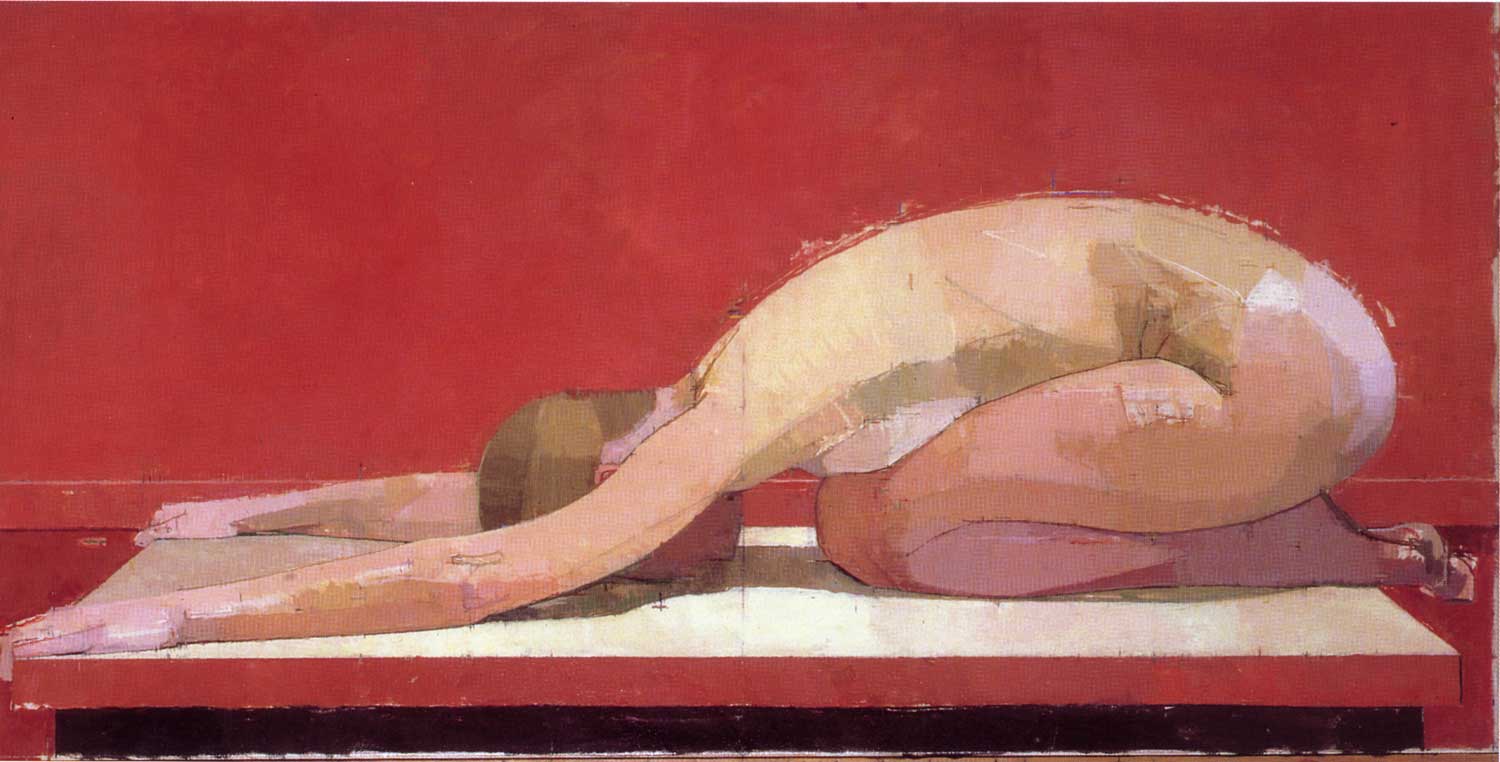
Euan Uglow (1932-2000) used construction lines when plotting his drawings and subsequent paintings. The simple beauty of his paintings belies the painstaking mathematical construction. He constantly measured and re-measured during the painting process. His method was time consuming and laborious. In some cases the underlying lines of construction can be seen showing through the paint as extra evidence of the hand of the artist.

Looking at the two drawings by Carl Philip Fohr (1795-1818) and Lucian Freud (1922-2011) there are some similarities between the two drawings although they were drawn more than a century apart. I saw these two drawings in Deanna Petherbridge's book under the title 'Economy and Focus in Capturing Likeness - Preserving Clarity, Selectivity and Compositional Resolution'  Both of these drawings do just what is described above. They are controlled drawings with precise outlines. Textural elements are controlled. The lines are confident - there are no pentimenti or revisions. The two artists have both arrived at similar solutions for their self portraits although one was not influenced by the other.

Lines to Represent Texture:

Below these two drawings of clarity and simplicity I have  revisited what could really be considered the opposite extreme - the work of Van Gogh who used a myriad of different lines, marks and Dashes to describe form and texture in his pen and ink drawings. (See Research point in part 1) 

Lines to Describe Movement or Energy

Under the heading 'Performativity- Traces of action', Deanna Petherbridge says " The uninflected and controlled outlines of neoclassical or outline drawing systems, often designated as remote, cold and mechanistic by commentators call for very different reading from that class of variable lines that appear to be marked by the hand and in extension the artist's body. Varying of inflected lines, which vibrate with their conditions of making, involve breaks, interruptions, stresses, thickenings and regular or disordered rhythms that appear to betray the emotive state of the artist.'


Edgar Degas (1837-1919)
Recognised popularly for his drawings of dancers, horse racing and women bathing, Degas made repeated charcoal drawings of similar subjects and poses. He used pastel extensively and build the drawings up in a painterly fashion using many marks and lines to indicate light and suggest movement.
I have included this drawing by Kathe Kollwitz (1867-1945) although it is a mainly tonal drawing because of the powerful zig-zag line of dense charcoal that extends along her drawing arm. This seems to fizz with energy as she works at the easel.

Willem de Kooning (1904-1997)
The drawing I have included here is untitled and apparently abstract but to me it reads as a woman. Here he has made exploratory marks and lines. Some of the lines of charcoal have been erased leaving ghost marks which add to the sense of movement here.

Walter Sickert (1860-1942)
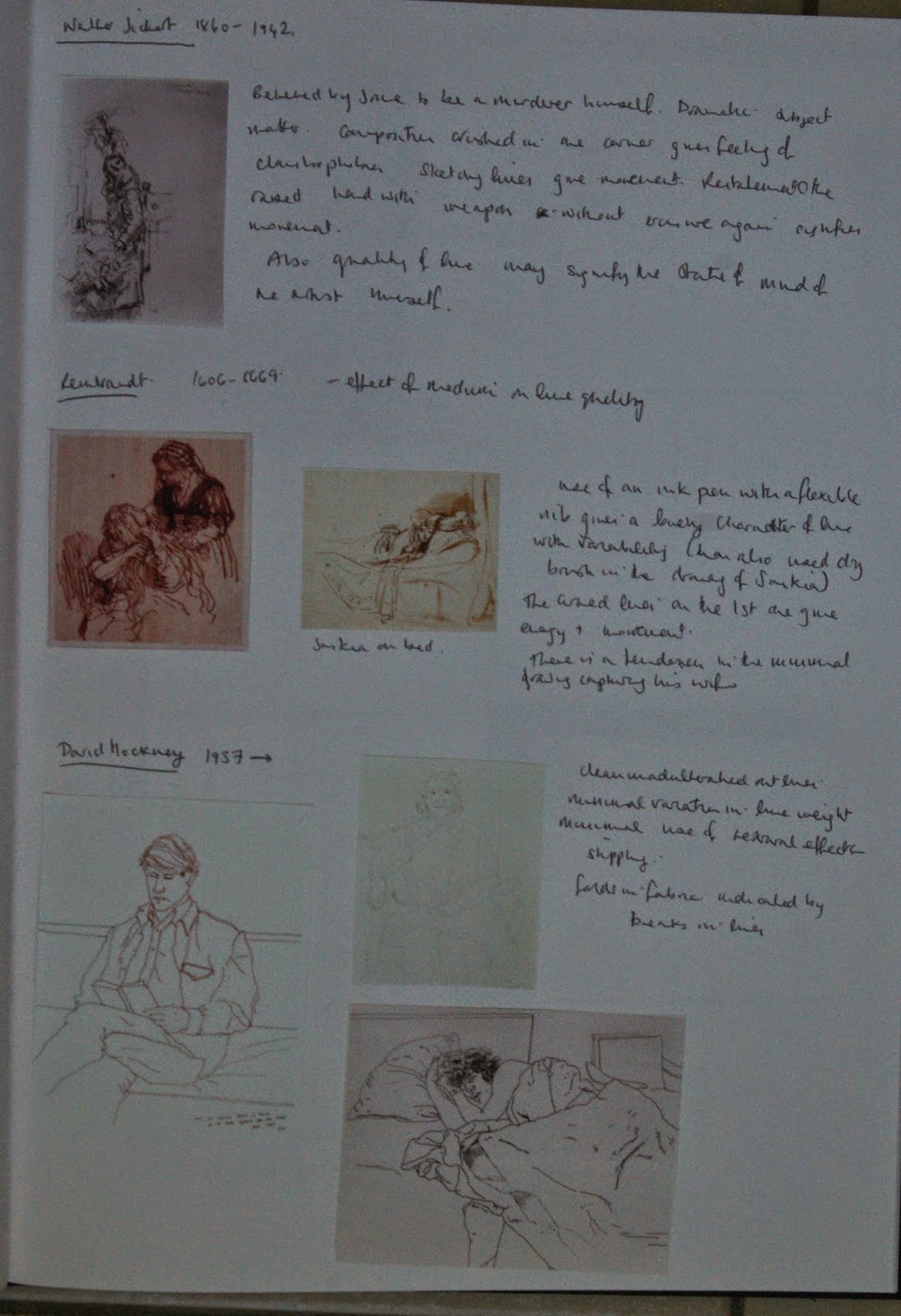
This drawing depicts an act of violence. 'He killed his father in a fight' is the title. Sickert is believed by some to have been a murderer himself. Here the composition is crushed into one corner of the paper giving a feeling of discomfort and claustrophobia being 'up close and personal' with this deed. The sketchy gestural lines give the impression of movement and the restatement of the hand with the weapon without erasure further signifies movement. The ragged and jagged nature of the lines may say something about the state of mind of the artist or may just speak about the subject matter of the piece.

Effect of Medium on Line Quality:

During this exploration I have seen a number of different media and their effect on the lines drawn - in particular charcoal can produce a variety of lines due to its ability to be smudges and erased leaving a ghost of itself on the page. In the two drawings by Rembrandt (1606-1669) he has used an ink pen with a flexible nub. I really like the character of these lines - there is great variability (he has also used a dry brush technique on his drawing of Saskia on a bed. The curved lines repeated on the first drawing encode movement. There is a particular tenderness in the handling of the lines and minimal drawing in the picture of his wife on the bed.

Graphic Lines:

David Hockney (1937- Now)
David Hockney's line drawing are simple and effective .There is no unnecessary embellishment - clean outlines with folds in fabric simply indicated by breaks in lines. The lines are unadulterated and uninflected. They certainly preserve clarity and focus in capturing the likeness of the people he is representing.

In the introduction to 'Drawing Now: Between the Lines of Contemporary Art' Tracey (I.B Tauris London/New York 2007) There is a passage which refers to the writing of Emma Dexter which talks about contemporary drawing moving away from mimesis and expressivity of inflected line towards the 'anecdotal and narrative, subjectivity and leanings towards the poplar and vernacular'  She is saying that in order to be authentic, contemporary drawing leans away from highly resolved and conventional modes of drawing towards the immediacy of 'dumb line'. However, like all movements this also eventually becomes an convention when self consciously applied. The authors quote David Shrigley (1968- Now) as an artist who has managed to successfully navigate this minefield being humorous cynical and self reflexive. His drawings are characterised by weak line work and poorly executed text with crossings out. His weak line is often corrected by the use of a ruler. Whether the weak line is a true manifestation of 'outsider art' in that he has no choice but to draw in this way not having the ability to make more resolved drawing, whether he deliberately chooses this style (more likely) or whether he is just seized by an immediate urge to communicate something and puts id down in a messy rush the viewer doesn't get to know. His drawings are like cartoons and often feature misshapen humanoid creatures drawn from the mind rather than from direct mimesis of observed objects. They are often cynical and provoke thinking about the absurdity of things that happen on an everyday basis. His humour is attractive but at the same time, the apparently unskilled nature of his drawings are challenge to the general public when hung in a major gallery. (This is the sort of thing my husband would hate because he would think that he could do it himself). In this I suppose he continues in the footsteps of people like Patrick Caulfield or the pop artists who do not like the broad divide and distinction between high and low art. I'm a bit ambivalent about his work. I find some of his drawings charming. Some have a poignancy about them and some are just plain funny - some of them I would buy and send as greeting cards (I have a sick sense of humour) but I'm still on the fence about their place as fine art. I still don't quite 'get it' - but then Shrigley also pokes fun at the art or the general public in art galleries world in some of his work. For example in this work here, and this work here http://www.davidshrigley.com/draw_htmpgs/blank_page/6_drawing.html in fact I ended up spending quite a long time on his website once I started looking! His work reminds me of Gary Larson's 'The Far Side' and also the unfired small clay statues by Fischli and Weiss that I saw at the Biennale in Venice last year which illustrated an eclectic mixture of moments from history and items from popular culture in a cartoonish way. I think it's time to wind this research point up now as I am starting to digress and the research could go on forever.


Reference Material:

The Primacy of Drawing- Histories and Theories of Practice by Deanna Petherbridge. (Yale University Press- 2010)

Drawing Now - Between the Lines of Contemporary Art TRACEY (I.B.Tauris & Co. Ltd. 2007)

Biographies of David and Ingres were also accessed at Oxford Art Online vie Bridgeman Education.


Monday, 9 June 2014

Part 4 : Other Research

I have looked at the work of numerous artists during this part of the course, some of these were suggested by my tutor and others I found on my own. The notes here are necessarily brief.

Euan Uglow

Uglow's main focus was on painting the figure. He had a very precise way of doing so which involved asking models to adopt poses which exaggerated simple geometric shapes and then taking multiple measurements and plotting co-ordinates. He continued to take and plot measurements throughout the process of painting and sometimes his measurement marks are still visible in the final paintings.

Click Here for Uglow Example 1 from Painting Perceptions website

Uglow Example 2 from Painting Perceptions Website

I like Uglow's work. Although the work is painstaking it is not done in this way to produce a photorealistic result. The painting is more than an accurate representation of the body in front of him. I like the way that he selectively simplifies the planes of colour and tonal values. I also like the fact that the means of production is visible in the final painting. He has resisted the urge to tidy everything away - you can see the process of making and thinking which went into the painting and to me this helps me find the artist in the painting. (It's a bit like the excitement I feel when I find the thumbprint of a famous long dead artist on examining a painting close up)

John Currin

Thanksgiving 2003 John Currin on Tate Website - Click Here

Looking at  Currin's works, I find many of the characters he portrays are repellent. His work leads me to make immediate judgements about their financial and social status and their personalities. He very skilfully passes and often critical eye over society (in particular American Suburban life) interweaving this with references from art history. In the example above he uses his wife Rachel as the model for all three women. There is a reference to loss of virginity or deflowering. The turkey is waiting to be stuffed which ties in with the woman's open mouth. The whole scene also recalls Parmigianino's "Madonna of the long neck'

Hope Gangloff

Click to link to the artist's website

Hope Gangloff's subjects are mainly her friends. They are young bohemian types often pictured partying or lolling around bleary-eyed with hangovers. They appear young and carefree which is an attractive lifestyle to portray. What I particularly like about her work is that her drawings seem to capture fleeting and unguarded moments and are not formally posed portraits or obviously constructed scenes for a particular narrative purpose. She often uses textiles in her work and the patterning of the textiles contrasts with the relatively simple treatment of her subjects' faces and anatomy. There is a lot of flat patterning and in this way her work reminds me somewhat of that of Gustave Klimt

Goya

There is a striking contrast between the work in Goya's Early Career and that in his later life. His early work was as a court painter and so the style is very formal and not particularly individual.

Later, his style changed dramatically and there were two major influences on this - the first was the Peninsular war after France invaded Spain. His processing of the events of the ear led him to create images with strong political motives including etchings entitles - 'disasters of war'  and the famous "Third of May 1808"

£rd of May 1808. Goya

Later he was troubled by severe illness which affected his balance, made him deaf and also lead to significant psychological suffering - some have suggested that this may have been the result of lead poisoning from the paints that he used. Whatever the underlying cause, his subject matter became much darker and he produced a series of disturbing images called his black painting or which 'Saturn devouring his infant son' is an example.

Saturn Devouring his Son

I realise that I have not done justice to any of the artists I have researched with these very brief descriptions. More research material can be found in my sketchbooks and there are numerous other artists I would like to explore here if I had an unlimited timescale. Unfortunately I am in serious danger of exceeding the time limit for this course so I will have to stop here and move on to part 5.


Thursday, 22 May 2014

Research Point: Self Portrait - Part Four

There are numerous artists today who use their bodies or faces or aspects of their lives either as the subject if their art or as the medium for creating art.

Tracey Emin

Although not known for her self portraits, Tracey has become a sort of celebrity/artist. Everyone knows about her life history, abusive childhood, sexual assault, abortions and so on. In effect her art and her life story are difficult to separate and many of her pieces are autobiographical (such as her tent embroidered with the names of everyone she had ever slept with and her unmade bed). So you could almost say a large portion of her body of work amounts to an extended self portrait.

Cindy Sherman

Cindy Sherman uses her face as a medium to create art. However, her works couldn't be described as self portraits (although they are photographs of her face). In these images she becomes someone else. She is an actress or a chameleon. In the pictures she is difficult to recognise. She portrays various stereotypes and also creates film stills from imaginary movies which seem very familiar. You can read the narrative into them even though there is no narrative only a construct.

Click here for one of her film stills


Ana Mendieta

The work of this artist who died tragically young is interesting. She used her body and face in may ways in performance art and in making silhouettes of her body in the earth. Many of her works address issues such as female beauty and sexuality and male sexual violence. It is a tragic irony that she fell 34 floors to her death leaving an imprint of her body where she fell and that her partner at the time was suspected of pushing her to her death.

Click here to link to an article in the Observer from 2013 about Ana Mendieta also click on the link "In pictures to see several examples of her work"

Dieter Roth

I first encountered the work of Dieter Roth at the Biennale di Venezia in 2013. Roth is well known for producing many self portraits in a variety of media including multiple chocolate busts of himself and self portraits with titles such as "self portrait as a flowerpot' and 'self portrait as a pile of dog dirt". Click here to link to examples of his work on the Tate website. A lot of his work involves self reflection and self questioning as well as questioning of his work as an artist and the value of an art object. 

The work I saw at the biennale was "solo scenes" (1997-98). This consists of 131 TV monitors and VCRs all showing scenes from the artist's everyday life. The camera is fixed and Roth wanders in and out of the frame going about his daily business and doing nothing in particular. He has a shower, eats his dinner and tinkers with work in the studio. If he wanders out of the frame nothing happens. The number of the screens containing activity means that it is difficult to concentrate on one particular screen - your eye is drawn away to check out other screens in case something more interesting is happening. I found this installation quite poignant given the knowledge that Roth is no longer alive and was quite ill when he made this. To it chimes with the thought of our own mortality and the fact that simple everyday activities assume a greater significance when there is a limited time left and the end is near. This was most likely nothing to do with the artist's intention but was my own personal response to the work. I found it quite moving. (despite the continuous very distracting and very annoying hum of Bruce Nauman at the other end of the room - click to link to video Raw Material With Continuous Shift - MMM an artwork which succeeds in its aim  to be a sensory onslaught and a grating encounter).

Back to Dieter Roth though - here is and excerpt from the catalogue of the biennale which goes some way to explaining the scope of the work. " This enormous catalog of moving images shares some of the qualities of a memoir: its surveillance-like archive hints at an impossible interiority , perhaps fictionalising the notion of a private self beneath the realm of surfaces. Presenting the artist's activities all at once , the frenetic display begs to be navigated, making it impossible to rest on any single monitor. Ultimately the work denies both narrative and the intimacy of a self portrait: Roth shows us instead how one can wrest some sense of self from the stuff of one's daily life"


Reference Material used: 
"A Face to the World - On Self Portraits" by Laura Cummings (Harper Press 2010). 

The Oxford History of Art "Portraiture" by Shearer West (Oxford University Press 2004) 

"Il Palazzo Enciclopedico - The Encyclopedic Palace - Short Guide" La Biennale di Venezia 55th Esposizione Internazionale d'Arte ( Marsilio 2013)

"Ana Mendieta: Death of an Artist Foretold in Blood" Sean O'Hagan Observer Sunday 22nd September 2013


Wednesday, 21 May 2014

Research Point: Self Portraits - Part Three

Why do artists paint self portraits? There may be many possible reasons: As a product for sale (see above and below about Rembrandt), to show off technical skill (see Parmigianino), as a convenient way to practise facial expressions (Rembrandt again), to proclaim their status (see Dürer, Velazques,Van Dyck) and their purpose in life as and artist (Artemesia Gentileschi, Philip Guston)  or as a sort of visual autobiography (Rembrandt again).  Over the years the purpose of self portraiture has developed further; some have used it as an exploration of psychological or physical states ( Egon Schiele, Frida Kahlo, Edvard Munch, Ernst Ludwig Kirchner) or as a means of social commentary (Felix Nussbaum - self portrait with Jewish Identity Card 1943). Some prolific self portraitists are simply narcissists (Courbet) while others use their body as a means to express something and are portraying concepts or characters other than themselves (Cindy Sherman, Ana Mendieta). 

As time progressed, artists started to explore other uses for self portraits - in particular their use to explore their own mental, physical or spiritual states of being.

Egon Schiele

click to access link to one of Schiele's self portraits on the MOMA website

A lot of Schiele's work is concerned with the human body, sexuality and death. He painted many self portraits during his career and they all seem to have a psychological intensity to them. Physically he is stick thin and angular which makes for some very striking images. In one image he even portrays himself as saint Sebatian in a hail of arrows as if to say he is prepared to suffer and die for his art.

Ernst Ludwig Kirchner

Click to link to Self-Portait as a Soldier

In this expressionist work of 1915 was painted not long after Kirchner was discharged from military service as being unfit for service for psychological reasons during World War One. He portrays himself in uniform with cigarette in mouth, He is in the studio and there is a model but he has his face turned away from her. His eyes are dark as if they are unable to see and his painting hand is severed. This is not a pleasant image and clear expresses how Kirchner feels emasculated and stunted creatively by the affects of the war.

Frida Kahlo

"I've done my paintings well and they have a message of pain". Frida Kahlo's pain is well documented both physical resulting from a bus accident and psychological pain from her relationship with her unfaithful husband. Her paintings have a child-like quality but her face is always clearly recognisable with her characteristic monobrow. She is like an icon or her own logo. Some also argue that there is political content to many of her self portraits. Whatever the truth and despite her simple treatment of her own features, her surrealist self portraits do not fail in their scope of communicating pain.

Click here for image of Broken Column on Learner.org

Click here for "wounded Deer" On Frida Kahlo. Org

Edvard Munch

Click Here for Edvard Munch's 'Self Portrait in Hell' 1903 on Wikimedia

Laura Cumming describes Munch as an "enthusiastic miserabilist" which is demonstrated in this self portrait. He is not really in hell but paints himself as a victim of psychological torment. This is apparently how he felt during the fallout after the tumultuous end to a doomed affair during which he accidentally shot off the end of his own finger (both lovers were trying to out do each other as to who was going to kill themselves first - in the end both survived but Munch described himself as living in a kind of hell afterwards). 

Both the picture and Much's description of events are all rather melodramatic. however, the self portrait does communicate a sense of discomfort and hopelessness so I guess on that level it succeeds.

Felix Nussbaum

Here we touch on social commentary. This artist portrays himself against a dark grey background and a forbidding sky showing his Jewish identity card and the star of David on his coat. The painting feels claustrophobic with an atmosphere of tension and fear - as it should with the subject it depicts. Nussbaum eventually became a victim of the gas chambers at Auschwitz

Click Here for Self Portrait with Jewish Identity Card 1943 on Wikimedia

Gustave Courbet

Was by no means a private person - he liked to live life open to public scrutiny. If he were alive today I would imagine him as a 'celeb' constantly updating his blog and his twitter feed. He liked to have himself photographed always trying to show himself off to his best advantage. He painted numerous self portraits - in some of which he played a role - for example he played a cello in one painting even though he didn't know how. Whatever the story, Courbet was the main protagonist. There isn't any soul searching going on here - the artist is quite simply in love with his own presence. Even over the passing of the years he does not acknowledge any deterioration in his looks and paints himself as young and robust. 


The Meeting 1854

In the meeting Courbet is greeted by a welcoming party from the town where he is arriving. These important dignitaries from the town afford him the greatest respect - taking their hats off and lowering their gazes.  Courbet's fellow artists at the time thought this was hilarious - pointing out they only Courbet had a shadow as if 'he alone could stop the rays of the Sun" the painting got two nicknames "Bonjour Monsieur Courbet" and "Fortune bowing to Genius".


Reference Material used: 
"A Face to the World - On Self Portraits" by Laura Cummings (Harper Press 2010). 


The Oxford History of Art "Portraiture" by Shearer West (Oxford University Press 2004) 


Tuesday, 20 May 2014

Research Point: Self Portrait- Part Two

Why do artists paint self portraits? (continued Self Portraits - Part One)


Demontration of Technical Skill

Self Portrait in a Convex Mirror, 1524
Parmigianino
The young Parmigianino painted this self portrait to demonstrate his skills as he was seeking a wealthy patron (which he succeeded in gaining). Flat mirror were not common at this time and this painting describes the distortion of the reflection in the mirror with its unusual composition with the magnified hand in the foreground. The painting in fact is painted on the context surface of a wooden hemisphere which was of the same dimensions as the mirror he used.


Proclamation of Status

In part one I describes how Dürer was concerned with raising the status of the artist going to the extreme of portraying himself as an icon of Christ. 

In the portrait below the artist seems to be 'showing off'. It strikes me as being similar in character to many of the 'selfie' photos on social media sites these days documenting life events but contrived to look gorgeous in the process. Here Sir Anthony van Dyck (who was court  painter to Charles I) is proudly displaying a chunky gold chain while gesturing towards a sunflower. He seems to be saying 'look at me! I'm such a fabulous painter that I won a big chunky gold chain for painting these golden sunflowers'. He's wearing red satin - all very 'bling' and ostentatious - If he were around today he's probably be a rapper!

Sir Anthony van Dyk Self Portait with a Sunflower
In contrast - I will look briefly at Las Meninas (Velasquez) seen below - but the brief description will not do it justice as this is avery complex painting:

Las Meninas 1656 - Diego Rodriguez de Silva y Velázquez
Clearly this is not 'just' a self portrait showing Velázquez as the court painter. It is a complex and carefully planned composition. The little infanta and her maids look out at us but Velazquez himself looking gravely out at us seems really to communicate and make the views part of the scene. it's almost as if he is painting us as part of the scene across the centuries. (Although he may actually be painting the king and queen who are reflected in the mirror at the back of the room). This is a lll a construct, an inclusion but a very compelling one.

Practising Facial Features and Experimenting with Techniques

Rembrandt clearly did some of this as I referred to in part 1. Van Gogh may have been forced to repeat his self portraits, not necessarily because he was exploring his state of mind (although we might like to think that after the subsequent publication of his letters and his premature death to promote the idea of the tortured genius). It may have been expedient because he was short of money and could, therefore not afford to pay a model. The results are spectacular and the artis recognisable for those brush strokes and those spectacular colour schemes rather that for consistency in the facial features.


Portraying the artist in the process of painting

One of my favourite self portraits of this section is that of Artemisia Gentileschi. This female artist  is a touchstone for may female artists given that she triumphed over adversity (she was raped as a teenager and underwent the indignity of a trial which made her ineligible for marriage but went inn to become a very successful artist at a time when female artists were very rare).

Self Portrait as La Pittura 1638
(Self Portrait as an Allegory of Painting)
Artemisia Gentileschi
What I like about this is the energy that she shows. She is leaning forwards looking round an enormous canvas as she paints her subject. The act of painting uses her whole body which seems believable. Compare this with the ridiculous image below in which the lady in all her fine satin is teaching pupils how to paint in oils. 

Adelaide Labille-Guiard 1785
Self-Portrait with Two Pupils
Notwithstanding the virtuosity of the painting of the folds and sheen of the satin, my immediate reaction to Labille-Guiard was contempt.

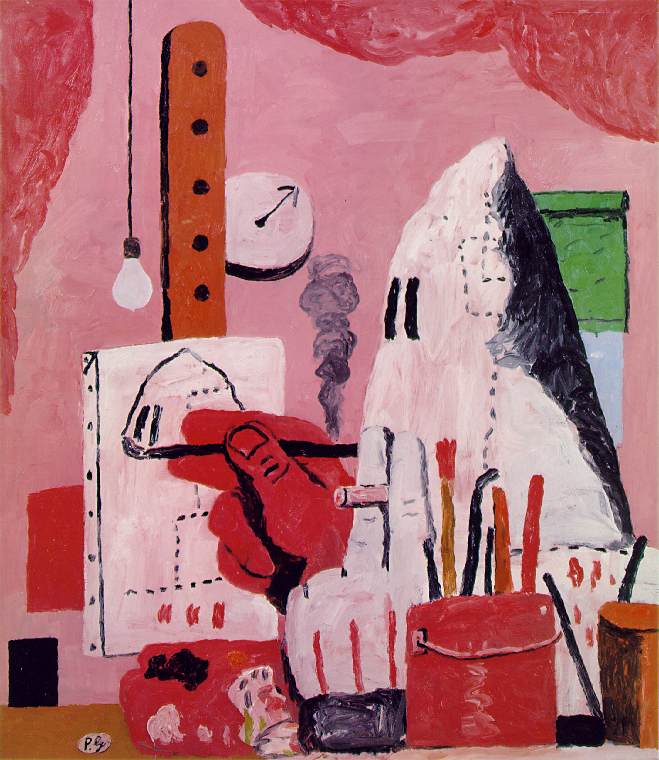
At another extreme comes Philip Guston with his 1960 painting "the Studio" Click Here for Link to Image. The artist looks like a faceless member of the ku-klux clan or a halloween ghost with a sheet over his head. He paints a crude likeness of himself under a bare electric bulb (late at night) with a paintbrush that seems to smoke because of the cigarette he is smoking with the other hand. His hands are stubby and clumsy- he casts himself as a clumsy and un-creative buffoon. But to those in the know there are a number of references to previous high art in this picture.


Reference Material used: 
"A Face to the World - On Self Portraits" by Laura Cummings (Harper Press 2010). 

The Oxford History of Art "Portraiture" by Shearer West (Oxford University Press 2004)