Thursday, 24 April 2014

Exercise: Portrait from Memory


These drawings can be found in Sketchbook pages 48-52 and page 55.

I found this exercise extremely difficult. I don't think my visual memory is very good at all. Either that or I have difficulty translating my visual memory onto the paper.

My first attempt was a portrait of my father. He was on my mind as he has been quite unwell recently. I drew the portrait from memory. I couldn't resist the urge to embellish it with shading and smudging as if to compensate for the lack of accuracy (which of course it didn't - it still didn't look much like my dad - I hope he never sees it!). The basic features are there - beard and bushy eyebrows but the drawing in general feels like a step backwards in comparison to what I'd been doing with the self portraits.


I tried again using someone who I'd seen briefly while watching some rubbish on TV (one of those shows on which young girls try to become models). One of the girls had such striking features that I thought it must be easy to fix her in my memory to draw her. She had a wide eyed look with a very heart shaped face and large lips - she seemed to look permanently worried. My drawing again looks quite naive and child like. In some ways this suits the character of the model but I was confused as to why these drawings from memory should end up looking like a teenager trying too hard had drawn them.


I suspected that what may be happening was that lacking confidence in my ability to recall well enough to draw I had become overly analytical - saying to myself " the eyes are hooded, the eyebrows are bushy" and so on. I thought that maybe the drawing would go better if I used methods more akin to those I used for gesture drawing, so I tried again. This time I tried to hold a visual image of the person in my mind's eye and draw as if I were doing a blind contour drawing from life. This led to much more uninhibited drawings . They weren't any better in terms of likeness but they did capture the essential elements and differences between the two people and I prefer them to my first attempts


Monday, 21 April 2014

Exercise: Self Portrait


These Drawings can be found in sketchbook 6: Pages 19 -23.

My first attempts at a self portrait were done following exercises from a book: "Drawing and Painting People - A Fresh Approach" By Emily Ball (Crowood Press 2009). I found this little book quite inspiring. The first exercise I did involved pushing and pulling around crushed charcoal to try to establish the structure of the face and then working into it with a putty rubber and more charcoal.


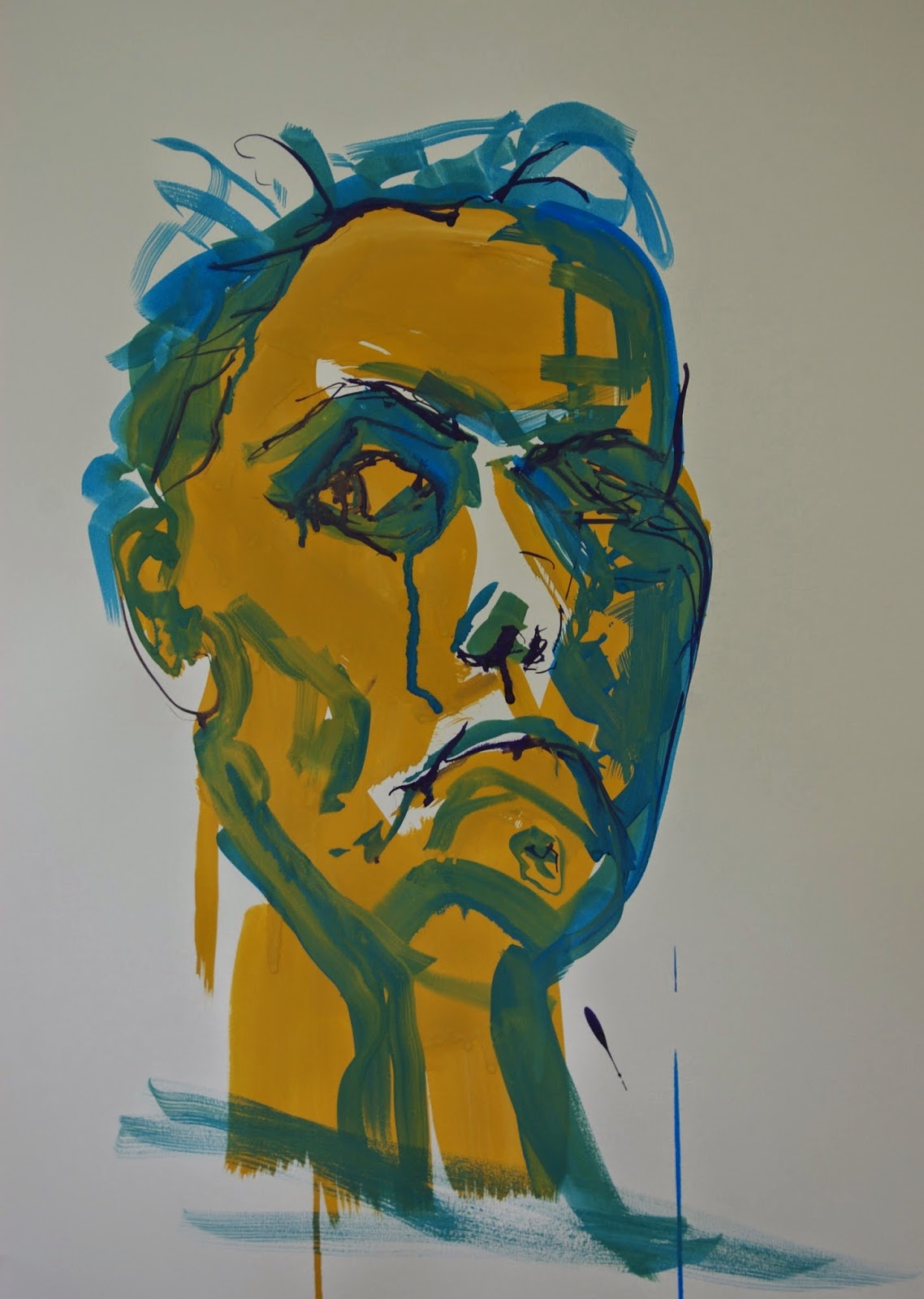
May favourite exercise was "Three colours, three brushes, one head". I used gouache for this exercise. One brush was a large decorator's brush, the second was medium sized and the third was a rigger. I started with a few strokes of the large brush to describe the basic structure and rises and falls of the face in just three strokes. The worked with a different colour on each brush to describe the details. I decided not to choose natural-looking colours. On my first attempt I think I overworked it and also the proportions are off with the eyes being too big and the nose too small. Since this was such a rapid way of painting I had plenty of time to try again.


I was much happier with my second attempt. I managed to resist the urge to over embellish it and I think this painting is much more successful. It really captures my sidelong glance and look of frowning concentration. The accidental run of paint below my eye and the downward turn of my mouth leads everyone who sees it to say I look miserable. It isn't the best likeness of me - once again I have elongated my face. I do, however feel this is a successful drawing/painting.


I had another attempt at a colour portrait using Inktense blocks and water soluble coloured pencils on Bockingford paper. I really got bogged down with this one. It has none of the freshness and vitality of the above exercise. I does look like a face but not my face! With this medium I found it very difficult to make alterations as I went along. I sin't possible to erase and only so many layers can be built up. I quite like the gaze of the eyes on this one but otherwise I don't think this drawing is so successful.


This final drawing in charcoal and white conte' crayon is by popular opinion (of my friends and family) the best likeness of myself that I produced. I started this one by putting a mid tune over the whole head and then subtracting and adding until the face emerged. About halfway through the process it looked hopelessly unlike me and cross-eyed. By continuing the process of addition and subtraction I was able to resolve this into a reasonable likeness so I'm glad I persevered.


Wednesday, 16 April 2014

Project: Self Portrait. Exercise: Drawing Your Face

This exercise can be found in sketchbook 4 : Pages 50-61


First attempts with charcoal and with drawing pen
The profile drawing is wrong as the face and head as
a whole are too narrow and elongated

Graphite sketches and a dawning done blind while feeling my face
The top left drawing looks too masculine - the brow and chin
are too strong

Just for fun I experimented with placing a sheet of tracing paper
on my face and rubbing graphite over it.The results remind me of ancient
stone carvings.

More attempts with drawing pen and with ink and wash. I am
noticing a tendency to overestimate the size of my eyes and
also a repeated tendency to elongate my chin

Further experiments with different angles and lighting. The face lit from
below looks nightmarish. Some of these angles are from
photographs as it was impossible to see these angles with a single mirror 

Trying to simplify the representation of facial features and looking
more closely at facial proportions.

I had more time to work on the self portrait project because it did not require me to pin down another person to model for me. I try to look in the mirror as little as possible these days as the ageing features don't correspond with how I feel or how I want to look. It is quite difficult to be objective when studying your own face, However, over the multiple sketches I got more familiar and less daunted by the subject.

Tuesday, 15 April 2014

Check and Log:The Moving Figure

How well  did you manage to convey the sense of a fleeting moment rather than a pose?

I do think that most of m y drawings in this section convey a sense of movement and fleeting moments. This is because they were, by necessity drawn extremely rapidly. I think the most successful drawings are the continuous line drawings, most of which were drawn virtually blind with just the occasional peek at the paper or the i-pad screen (I often draw on the i-pad in the airport as it makes me feel less conspicuous than drawing on paper). These drawings have a partially abstracted quality about them which I like but they still 'read' as human forms.

How successful were your attempts to retain an image and draw later?

Not successful at all! This exercise has led me to understand that my visual memory is really quite poor. Any attempt to draw someone's previous position after they had moved resulted in a very stiff 'stick man' appearance. I seem to panic when the image to be drawn is no longer in front of me. I guess this requires more practice.

Were you able to keep to a few descriptive lines to suggest the person's movement or were you tempted to keep introducing more elements into your work?

This improved as I did more sessions of drawing at the airport. Initially my sketches looked a bit  hesitant with multiple lines and complete outlines of the figures. Gradually I began to control the impulse to be over detailed as I realised how little was required for the figure and movement to be readable. The more successful drawings are the continuous line drawings especially those drawn 'blind' on the i-pad and those drawn  with a bamboo pen and ink.


Monday, 14 April 2014

Research Point: People watching

A man explaining something to a woman. There was a
lot of pointing and gesturing going on. It was clearly something
he felt very strongly about 

Bored people in a queue just standing idly around and
staring vacantly into space or listening to music. I alike the abstract
quality of this line drawing. they are only just readable as
human forms


I was truck by this man's way of sitting - he was leaning back
on an airport chair with one leg stretched right out in front of
him and the other akimbo. This seemed a very masculine pose
it looked as though he was relaxed and felt he owned the place.
This was in contrast to the women next to him who were gathered in
and cross legged.


Two travelling companions consulting a map


Most of my drawings are done at the airport. There are dejected weary travellers with heavy bags. Mothers trying to soothe  babies. Couples arguing and the general confusion of airport queues. All of these contain very little detail particularly around the head and face. It is surprising how little is required for our brain to read an image as human. What I haven't successfully achieved however is the differences in facial structure between men and women. Men have stronger brows and chins. However, I have not produced any facial detail in any of my drawings.


Amidst all the confusion of an airport queue, the large guy
 in the centre was bring to use his big shoulders to shove
and jostle his way towards the front.

Thursday, 10 April 2014

Exercise: Fleeting Moments

It was a sunny Sunday so we took a day trip to Sorrento. There is a terrace which overlooks the bay of Naples and Vesuvius providing a spectacular view. When we arrived there  there was a large group of Japanese tourists already there. I found watching the people more interesting than looking at the view (which I've seem many times before). Very few of the people there were looking at the scenery without the view being mediated by a screen of some kind - either a table or a camera of a phone. I did deverel quick sketches of the tourists taking selfies and photos of each other to document their trip to this place on social media.

I liked the angle of the pose of this guy as he leaned casually on the railing for his friend to take a photo:


This elderly lady in a beret and a hooded jacket looked slightly bewildered. She had her phone in hand but seemed a bit uncertain as to what to photograph. I think this is the most successful drawing of this series as I used continuous line and was more selective than in the previous four drawings. I subsequently reproduced this drawing using an adaptation of the 'oil transfer' technique I saw at the Klee exhibition. I covered one side of an acetate sheet with oil pastel and redrew the line drawing on the reverse side so that it was transferred onto the paper beneath. I then embellished the background with watercolour.


I also did a rapid sketch of my son leaning on the railing and glancing back towards me. I used the oil transfer technique again and coloured pencil to reproduce this drawing:


Wednesday, 9 April 2014

Project: The moving figure. Exercise: Sitting and Waiting


I spend a lot of time in airports and this provides a good opportunity for people watching. Initially I started out by using a small sketchbook. The initial drawings are quite sketchy with multiple lines of uncertainty - this is partly the result of self-consciousness when drawing in public places. As time went on I made an effort to improve this by reverting to continuous line drawing and gave myself permission not to get tied up in thinking about proportions. People move all the time - it is rare for even queuing people to stand still for longer than a minute - they constantly shift their weight from foot to foot or look around or talk and gesture. Drawing people in public requires rapid and confident hand movements and retaining movements for a short time in the visual memory.

I liked the quality of the biro sketches and adapted some of these in the last sketch which I did with a bamboo pen and brown ink. I think the addition of the perspective of the queue as well as the continuous line make the drawing quite dynamic. I particularly like the woman walking away from us pulling a small suitcase.